













FAIR is a non-profit organization dedicated to providing well-documented answers to criticisms of the doctrine, practice, and history of The Church of Jesus Christ of Latter-day Saints.
m (Bot: Automated text replacement (-\|sublink +|L)) |
m (Bot: Automated text replacement (-{{Articles FAIR copyright}} +{{FairMormon}})) |
||
| Line 1: | Line 1: | ||
{{ | {{FairMormon}} | ||
<onlyinclude> | <onlyinclude> | ||
{{H1 | {{H1 | ||
Summary: This summary page contains bibliographic references for various electronic and print items that discuss -- or are related to -- the 'Mormonism and Freemasonry' issue. The materials that are listed here represent a variety of opinions that are held by Latter-day Saints on this topic. They also represent differing levels of review and publication processes and divergent degrees of documentation.
Jump to Subtopic:
Question 17: Was Joseph Smith, Jr., a Mason?
Answer: Joseph Smith the Prophet was a Mason. [1]
Jump to Subtopic:
Jump to Subtopic:
Teachings |
|
History |
|
Race |
|
Critics |

Yes. Brigham Young, along with many other men in Nauvoo, joined the Masons at Joseph Smith's encouragement.
When the Latter-day Saints occupied Nauvoo, Illinois, in the year 1842, there were approximately four thousand residents inside the city limits (twelve thousand by 1844),1 but only thirty people in the general area had membership in the Masonic fraternity. Among this small group were such notable men as Hyrum Smith (the Prophet’s brother), Heber C. Kimball (an Apostle), John Smith (the Prophet’s uncle), Newel K. Whitney (a bishop), and George Miller (another bishop)....
There is no evidence that Joseph Smith played a direct role in trying to get a Masonic lodge established among the Saints, though it must be admitted that the Masons adhered to principles that would have been especially attractive to the leader of a frequently (and recently) persecuted people. "Freemasonry is one of the strongest binding contracts that exists between man and man," said Elder John Taylor of the Quorum of the Twelve Apostles.10 And according to Apostle and Master Mason Heber C. Kimball, a member of that society could expect other Masons to step forward in time of need to render assistance. These fraternal brothers were expected to be faithful to each other "in every case and under every circumstance, the commission of crime excepted."....
[On] 7 April 1842 [Joseph attended the] initiation of Brigham Young.
[On] 9 April 1842 [Joseph attended the further] initiation of Samuel Smith, William Smith, Brigham Young, and Willard Richards.[4]
No. Brigham Young was a Mason, but was not a 33rd degree Mason (technically an auxiliary degree of the Scottish Rite). It would have been impossible for Brigham Young to become such, since that degree was first introduced in Illinois masonic lodges (the only lodges to which Brigham had access prior to the exodus to Utah) in 1857, long after Brigham's departure. (The 33 degree did not become formalized in the Untied States until the early 1850's with the work of Albert Pike and Dr. Albert G. Mackey.)
It is important to understand the nature of the appellate bodies in Masonry. While a 33 degree mason might sound impressive, in fact such a person hold no more authority in Masonry than does the typical Master Mason (3rd degree). The appellate bodies are under the control of the Grand Lodge of a state or territory and a Grand Lodge is made up of all the Master Mason in that state or territory. The highest office any Mason can hold is that of Grand Master of a Grand Lodge and the only requirement to be elected to that office is to be a Master Mason. Therefor the highest degree that any Mason can hold is that of Master Mason (3rd Degree). The appellate degrees are appendages to that degree and not "higher" degrees as they are sometimes presented.[5]
Utah territory had no lodge until 1872. Such a lodge would have been a prerequisite for any Scottish Rite appellate body to be formed.
While there were at least two abortive attempts to form a Grand Lodge in the territory by the Mormons, one by means of an application to the United Grand Lodge of England which seems to have been lost and never reached that body and another made to a Grand Lodge in Mexico which was rejected. Masonry by and large was not practiced by the Mormon population in Utah in Brigham Young's day. Indeed, the Grand Lodge of Utah was not formed until 1874 and it then imposed a ban on Mormons being members. This even precluded Mormon Masons from other jurisdictions from visiting Utah lodges. This would continue in some form until 1984.
Thus, it would have not have been possible for Brigham Young to have received the 33 degree designation while in Utah. Given that the 33 degree is an honorary designation (that is, it is given by the vote of others holding the degree) it would seem unlikely in the extreme that such an honor would have been given to Brigham who, at the time, was generally held in low regard. Likewise, the Mormons in general were viewed with disdain by the general population of Americans, and the above-mentioned hostility of the Grand Lodge of Utah towards Mormons also makes claiming that Young was honored in this way implausible.
Perhaps most telling of all is there is no documentary evidence of Brigham Young ever receiving such a degree either from the Northern Jurisdiction of the Scottish Rite of which the Grand Lodge of Illinois is a member or in the Southern Jurisdiction of which the Grand Lodge of Utah is governed. While in the early years of those rites some record keeping was lost or not well kept by the mid-19th century when Brigham Young would have been able to receive such a degree the records of both jurisdictions are very complete. Those records are silent in this matter.[6] < Back to FAIR Answers Index
Summary: Critics argue that symbols found on Latter-day Saint temples—particularly the sun, moon, stars, inverted five-pointed stars, and the "All-Seeing Eye"—are evidence of occultism, Satanism, paganism, or improper borrowing from Freemasonry, and therefore cast doubt on the Christian character of the Church. Critics especially point to the inverted star and the All-Seeing Eye as allegedly sinister or Masonic symbols.
These temple symbols are neither occult nor uniquely Masonic, but are Christian and scriptural symbols whose meanings were explained by Joseph Smith and early Latter-day Saints as representing Christ, the Church, divine knowledge, and revealed temple teachings.
I've heard there are some strange symbols on the Nauvoo and Salt Lake temples. My non-member friend claims these have an "occult" significance. Some people are of the opinion that they are Masonic. [7]
Latter-day Saint Temples are directed to the worship of the Lord Jesus Christ. Symbols can have multiple applications in different cultures; the intent of Latter-day Saint symbols have been explicitly described by the prophets, architects, and craftsmen involved. All are focused on the worship of God and His Son. The "occult connection" exists only in the mind of the critic.
The symbols located on the exterior of the Nauvoo Temple can be directly connected with a vision shown to the Prophet Joseph Smith.
In a revelation given on 19 January 1841 (which is about the Nauvoo Temple) the Lord Jesus Christ stated: "I will show unto my servant Joseph all things pertaining to this house" (D&C 124꞉42; emphasis added).
Joseph Smith later confirmed to the temple's chief architect, William Weeks, "I have seen in vision the splendid appearance of that building." The Prophet insisted that it be built according to the "pattern" that he had been shown.[8]
The Prophet was once asked by a stone carver, with regard to one of the sunstones he was working on, - "Is this like the face you saw in vision?" To which the reply was, "Very near it".[9]
Even though the exterior symbols on the pilasters of the Nauvoo Temple are the sun, moon, and stars it should be understood that they are not arranged in the sequence that is associated with the three degrees of glory (i.e., star on bottom = telestial kingdom; moon in the middle = terrestrial kingdom; sun on top = celestial kingdom). Rather, the sequence on the Nauvoo Temple is moon (bottom); sun (middle); star (top). The physical arrangement of the symbols on the outside of the Nauvoo Temple indicate that they do NOT represent the three degrees of glory.
These symbolic images can be matched up with information provided in the Joseph Smith Translation of the 12th chapter of the book of Revelation. There it is said of a vision that was shown to the ancient apostle John, "And there appeared a great sign in heaven, in the likeness of things on the earth; a woman clothed with the sun, and the moon under her feet, and upon her head a crown of twelve stars" (vs. 1). Thus, the moon is placed at the bottom, the sun in the middle, and the stars on top. In verse 7 of the same chapter the Prophet clarifies that "the woman . . . was the church of God."
Wandle Mace—the foreman for all of the framework done on the Nauvoo Temple—left behind a statement that makes a clear connection between the visions of John the Revelator and Joseph Smith. He said,
The order of architecture [on the Nauvoo Temple] was unlike anything in existence; it was purely original; being a representation of the Church, the Bride, the Lamb's wife. John the Revelator, in the 12[th] chapter [and] first verse of [the book of Revelation] says, 'And there appeared a great wonder in heaven; a woman clothed with the sun, and the moon under her feet, and upon her head a crown of twelve stars.' This is portrayed in the beautifully cut stone of this grand temple.[10]
Thus, the symbols on the outside of the Nauvoo Temple are a representation of the Church of God. And since the symbols are displayed in a heavenly setting they can naturally be associated with the Lord's heavenly Church, or what is sometimes referred to as The Church of the Firstborn. The Encyclopedia of Mormonism indicates that "the Church of the Firstborn is Christ's heavenly Church, and its members are exalted beings."[11]This is significant because on 4 May 1842 Joseph Smith gave the Nauvoo-era temple endowment for the first time to several of the Saints. The Prophet said that these ordinances consisted of "washings, anointings, endowments and the communication of keys pertaining to the Aaronic Priesthood, and so on to the highest order of the Melchisedek Priesthood, setting forth the order pertaining to the Ancient of Days, and all those plans and principles by which anyone is enabled to secure the fullness of those blessings which have been prepared for the Church of the Firstborn."[12] Therefore, it appears that the Lord had symbols placed on the outside of the Nauvoo Temple that represented the nature of the ordinances that were to take place inside of that building.
| Main article: | Inverted Stars on LDS Temples |
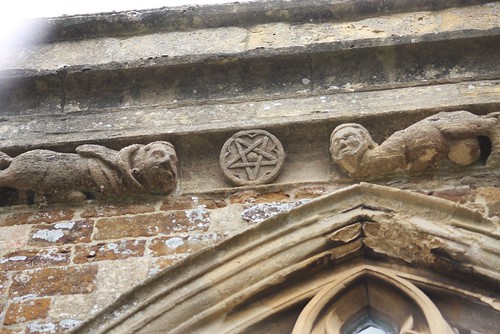
Critics of the Church are uncomfortable with the inverted five-pointed stars found on the stones and in the round windows of the Nauvoo Temple because in modern times they have come to be associated with Satan and devil worship. It should be noted, however, that this association did not occur until after the death of the Prophet Joseph Smith.
It should be further noted that Latter-day Saints publicly disclosed their interpretation of the inverted five-pointed star when they built the Logan Temple in northern Utah. A contemporary newspaper report states that the star was symbolic of "the Star of the Morning"[13]—which in the New Testament is a title of the Lord Jesus Christ (Revelation 22:16).
Some critics of the Church claim that the inverted five-pointed star on some of its temples are a symbol of evil and thereby demonstrate that Mormonism is not really a Christian religion.
The Prophet Joseph Smith indicated that he received the pattern for the Nauvoo Temple by revelation (cf. D&C 124꞉42). He told the architect of the project, "I have seen in vision the splendid appearance of that building illuminated, and will have it built according to the pattern shown me."[14] The Prophet also stated that he had seen at least one of the exterior symbols of that temple in this vision.[15]
The inverted five-ponted star was first displayed on the exterior of an LDS temple in Nauvoo, Illinois in the early 1840s. (See here here here here)
One of the foremen who helped to build the Nauvoo Temple recorded what the emblems on its exterior represented. He said,
"The order of architecture was unlike anything in existence; it was purely original, being a representation of the Church, the Bride, the Lamb’s wife. John the Revelator, in the 12 chapter [and] first verse of [the book of Revelation,] says, 'And there appeared a great wonder in heaven; a woman clothed with the sun, and the moon under her feet, and upon her head a crown of twelve stars.' This is portrayed in the beautifully cut stone of this grand temple."[16]
Joseph Smith revealed the connection between the heavenly woman of the apostle John's vision and the restored Church. In the Prophet's revision of the King James Bible he modified Revelation chapter 12 verses 1 and 7 to read: “And there appeared a great sign in heaven, in the likeness of things on the earth; a woman clothed with the sun, and the moon under her feet, and upon her head a crown of twelve stars . . . the woman . . . was the Church of God.” (JST Revelation 12:1,7).
This is the same arrangement of the symbols on the exterior pilasters of the Nauvoo Temple—moon (bottom), sun (middle), and stars (top).
The stars are associated in the book of Revelation passage with a "crown" which is a symbol of royalty. In another section of the book of Revelation Jesus Christ proclaims His descent through the royal lineage that is within the house of Israel and then pronounces one of His titles: "I am the . . . offspring of David, and the bright . . . morning star" (Revelation 22:16). This is the title that nineteenth century Latter-day Saints assigned to the inverted five-pointed star. One of these emblems was put into place on the east tower of the Logan, Utah temple in 1880. An eyewitness to the event reported the following which was printed in a major newspaper: "Carved upon the keystone is a magnificent star, called the Star of the Morning."[17]
In 1985 Church Architect Emil B. Fetzer stated that the inverted stars on early LDS temples were not sinister but were “symbolic of Christ.” He said that when the Church “uses the pentagram or sunstone in an admirable, wholesome and uplifting context, this does not preclude another organization’s using the same symbols in an evil context.”[18]
A connection between the "inverted pentagram" and Satan "is almost certainly a 19th century invention by Eliphas Levi," who was a "defrocked priest."[19] He did not begin publishing references to this idea until 1854, a decade after the death of the Prophet Joseph Smith.
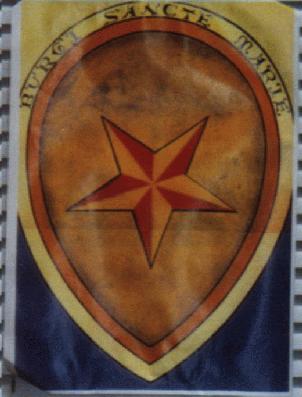
Below are links to examples of the inverted five-pointed star in ancient Christian usage and also numerous modern usages that have nothing to do with the occult or satanism.
The claim is sometimes made by critics that since the All-Seeing Eye of God is displayed on the exterior and interior of the Salt Lake Temple[20] and the All-Seeing Eye is an emblem utilized by the Freemasons then the Mormon usage must be an indication of a connection between Mormon temples and Freemasonry.
The All-Seeing Eye of God was not a symbol created by the Masonic fraternity and, in fact, was utilized as an emblem in Christian architecture long before Speculative Freemasonry became an organization.
Latter-Day Saints as a group became involved in Freemasonry in early 1842 but, as noted in the timeline below, the All-Seeing Eye of God was a well-established symbol among the Mormons long before this affiliation.
1828–29 – “I pray the God of my salvation that He view me with His all-searching eye” (2 Ne. 9:44).
1828–29 – “under the glance of the piercing eye of the Almighty God” (Jacob 2:10).
1828–29 – “the glance of [God’s] all-searching eye” (Mosiah 27:31).
December 1830 – “I can stretch forth mine hands and hold all the creations which I have made; and mine eye can pierce them also” (Moses 7:36).
2 January 1831 – “Thus saith the Lord your God, even Jesus Christ, the Great I AM, Alpha and Omega, the beginning and the end, the same which looked upon the wide expanse of eternity, and all the seraphic hosts of heaven, before the world was made; The same which knoweth all things, for all things are present before mine eyes. . . . mine eyes are upon you. I am in your midst and ye cannot see me” (D&C 38:1–2, 7).
13 August 1831 – “mine eyes are upon those who have not as yet gone up unto the land of Zion” (D&C 62:2).
1 November 1831 – “Hearken, O ye people of my church, saith the voice of Him who dwells on high, and whose eyes are upon all men” (D&C 1:1).
November 1831 – “Behold and lo, mine eyes are upon you” (D&C 67:2).
31 July 1832 – “my heart is naked before [God’s] eyes continually.”[21]
4 January 1833 – “the eyes of my Maker are upon me.”[22]
May 1835 – “the scrutinizing eye of ‘Him with whom we have to do.’”[23]
29 January 1836 – “[the] Lord had [His] eye upon thee.” [24]
9 May 1836 – “they stand naked and exposed to the piercing eye of Jehovah.” [25]
May 1836 – “God is not mocked with impunity. His all seeing eye beholds you at all times. . . . His all-seeing eye surveys the whole of His vast creation.” [26]
April 1837 – “the scrutinizing eye of Jehovah is ever upon them.” [27]
June 1837 – “In vain do they attempt to hide from the scrutinizing eye of Jehovah.” [28]
20 March 1839 – “Behold, mine eye seeth and knoweth all their works.” [29]
3 July 1839 – “the God of Jacob has His eye upon you.” [30]
September 1840 – “the all-searching eye of an Omnipresent God.” [31]
January1841 – “God that sheweth mercy; having His eye at the same time directed towards His covenant people.” [32]
13 December 1841 – “Let it not be supposed that the sick and the destitute are to be denied the blessings of the Lord’s house; God forbid; His eye is ever upon them for good.” [33]
Jump to Subtopic:
FAIR is a non-profit organization dedicated to providing well-documented answers to criticisms of the doctrine, practice, and history of The Church of Jesus Christ of Latter-day Saints.
We are a volunteer organization. We invite you to give back.
Donate Now