














FAIR is a non-profit organization dedicated to providing well-documented answers to criticisms of the doctrine, practice, and history of The Church of Jesus Christ of Latter-day Saints.
m (Bot: Automated text replacement (-{{SummaryHeader\n\|link=(.*)\n\|heading=(.*)\n\|summary=(.*)\n\|sublink +{{H1\n|L=\1\n|H1=\2\n|S=\3\n|L)) |
m (Bot: Automated text replacement (-\|sublink +|L)) |
||
| Line 6: | Line 6: | ||
|S= | |S= | ||
|L1=Baptisms for the dead | |L1=Baptisms for the dead | ||
| | |L2=The Mormon Endowment ordinance | ||
| | |L3=Mormonism and temple marriage | ||
| | |L4=Symbolism in Mormon temples | ||
| | |L5=Criticisms related to the temple | ||
}} | }} | ||
</onlyinclude> | </onlyinclude> | ||
Jump to Subtopic:
Summary: The Latter-day Saint practice of baptism for the dead has been criticized on various fronts. First, critics allege that the practice is not biblical and that Latter-day Saints misinterpret the Bible to support it. Next, critics allege that the practice is a form of "ancestor worship." Some have taken issue with Latter-day Saints performing vicarious baptisms for those of the Jewish faith who died during the Holocaust.
The Bible fully supports the practice. Baptism for the dead is not a form of ancestor worship, but a sacred ordinance that allows them the opportunity to enter the presence of God and worship Him. The Church of Jesus Christ of Latter-day Saints have made agreements to not use the names of Holocaust victims, and especially if those individuals are not relatives of current Church members, in temple ordinances.
Explained Elder G. Todd Christopherson:
Critics Jerald and Sandra Tanner claim that Church members' "obsession with the dead approaches very close to ancestral worship." In support of this, they quote Elder Adney Y. Komatsu, Assistant to the Council of the Twelve, Ensign May 1976, p.102. The critics wish to show that baptism for the dead is a form of "ancestor worship." In order to accomplish this, they extract phrases from a story told by Elder Komatsu about a couple that wished to be married, but were denied permission by the boy's parents. The use of genealogical research was the key that opened the door to allowing the couple to eventually be married. The authors carefully extract the phrases that they want to use, thereby making it impossible to see what Elder Komatsu was actually talking about. Baptism for the dead does not in any way represent "ancestor worship," and the authors had to search pretty hard to find a quote that they could butcher sufficiently to support this conclusion.
| Reference | Original quote... | Mined quote... | Use of sources |
|---|---|---|---|
| The Changing World of Mormonism p. 517. "This obsession with the dead approaches very close to ancestral worship." | May I share with you this afternoon an experience that happened to a young couple who were members of the Church in Japan. They wished to be married, and as is the custom in Japan, they sought permission from their nonmember parents for the marriage to be performed. The boy’s parents refused to give permission. With concern and disappointment, the young couple prayerfully sought ways to fill their lives with meaningful Church activities and trusted that permission would be forthcoming later.
At this time Church members were planning a trip to the Hawaii Temple, and much emphasis was made and was being placed on the importance of genealogical research. So the couple joined with others in seeking out their ancestors and in planning to have the temple work done for them. The girl searched diligently through shrines, cemeteries, and government record offices, and was able to gather seventy-seven names. The boy’s uncle, who was a respected and influential member of the family, heard of this and was deeply impressed with and interested in her work. He noted the intense devotion of the girl to honoring her ancestors and suggested that such a young lady would be a good wife for his nephew. Permission was granted for the young people to be married, and the marriage was performed. Later they were sealed in the Hawaii Temple. It is a Japanese tradition that families gather together for special holidays in January and August. As this young couple joined their family members on these special occasions, they displayed their book of remembrance, and much interest was generated in their work and in the reasons for it. They discussed with those relatives assembled their ancestral lines and the importance of completing the genealogical research. It was difficult for their nonmember families to understand the reasons for a Christian church teaching principles such as “ancestral worship,” for this was a Buddhist teaching and tradition. Today many young men and women are completing their family group sheets and are teaching the gospel of Jesus Christ to their parents and their relatives by this method. Through genealogical research and through doing temple work for their progenitors, and especially with a temple now becoming available in Tokyo, members can so live that the gospel will yet be embraced by many more in the Orient. This great work has just begun. —Elder Adney Y. Komatsu, May 1976 |
May I share with you this afternoon an experience that happened to a young couple who were members of the Church in Japan.... the couple joined with others in seeking out their ancestors and in planning to have the temple work done for them. The girl searched diligently through shrines, cemeteries, and government record offices, and was able to gather seventy-seven names.... As this young couple joined their family members ... they displayed their book of remembrance.... They discussed with those relatives assembled their ancestral lines and the importance of completing the genealogical research. It was difficult for their nonmember families to understand the reasons for a Christian church teaching principles such as "ancestral worship," for this was a Buddhist teaching and tradition.... Through genealogical research and through doing temple work for their progenitors, and especially with a temple now becoming available in Tokyo, members can so live that the gospel will yet be embraced by many more in the Orient | Elder Adney Y. Komatsu, Assistant to the Council of the Twelve, Ensign May 1976, p.102 |
Charles Penrose (1912): "Baptism for the dead—How do we know which of our deceased relatives are to be baptized for"?
Charles W. Penrose, "Peculiar Questions Briefly Answered," Improvement Era Vol. 15, Num. 11 (September 1912):
Question 12: Baptism for the dead—How do we know which of our deceased relatives are to be baptized for, and how do we know when we are to be baptized for them?
Answer: If instead of "we" the questioner had used the word "you," we would answer: Often by personal revelation, always by the law of kindred and genealogy, and the direction of those divinely appointed to administer the ordinances commanded.[8]
The most obvious of these is 1 Corinthians 15:29:
There have been attempts to shrug this off as a reference by Paul to a practice he does not condone but only uses to support the doctrine of the resurrection. These claims are indefensible. Paul's statement makes no sense unless the practice was valid and the saints in Corinth knew it. This is easily demonstrated if we just imagine a young Protestant, who doubts the resurrection, who goes to his pastor with his problem. The pastor answers him, saying, "But what about the Mormons who baptize for the dead? If the dead rise not at all, why are they then baptized for the dead?" You know what the young doubter would say. He would say, "Pastor, they're Mormons! What's your point?"
In fact, we know that baptism for the dead was practiced for a long time in the early church. As John A. Tvedtnes has noted:
Thus, baptism for the dead was banned about four hundred years after Christ by the church councils. Latter-day Saints would see this as an excellent example of the apostasy—church councils altering doctrine and practice that was accepted at an earlier date.
Tvedtnes continues:
Other sources can give credence to the Latter-day Saint position on this matter. Below we list a selective compilation of quotes from scholars that can demonstrate that:
The passage in the Bible is, at the very least, very short and cryptic. We can't know much about the practice accept the preceeding three assertions. Thus the following scholars would not affirm that the practice of vicarious baptism matches the modern Latter-day Saint conception of it i.e. that it was done on such a massive scale, for salvific purposes, etc. Some argue on linguistic grounds that this only had to do with catechumens (prospective converts to Christianity who died without baptism) but that is not fully substantiated by the text nor the historical context of the passage. Furthermore, as is noted by several scholars (a couple of which are included below), it is complicated by the fact that Paul spoke approvingly of believing Christians becoming vicarious, sanctifying vessels for non-believing spouses.[11] This could naturally be extrapolated to all kindred, non-believing dead.
There is much that we can't know from the text of the Bible itself following an exegetical approach. At some point, additional revelation is necessary to illuminate and expand on previous revelation. That would be the Latter-day Saint position. As Joseph Smith has said concerning the Restoration, it occured so that "a whole and complete and perfect union, and welding together of dispensations, and keys, and powers, and glories should take place, and be revealed from the days of Adam even to the present time. And not only this, but those things which never have been revealed from the foundation of the world, but have been kept hid from the wise and prudent, shall be revealed unto babes and sucklings in this, the dispensation of the fulness of times."[12] Latter-day Saints need not feel compelled to defend every last element of their theology from antiquity. Some elements may appear in seed and then be expanded on later by those "things which never have been revealed from the foundation of the world[.]" What 1 Corinthians 15:29 can tell us without a doubt is that the practice is ancient and that it wasn't rejected by Paul or others of the earliest Christians. The Greek of the passage is unequivocally said to support the notion that vicarious baptism was performed. Other revelation outside of the Bible can expand on it in the Restoration.[13]
Following is our selective listing of sources.[14] All bolded text has been added by the editor of this article:
Kevin L. Barney, Interpreter: A Journal of Latter-day Saint Faith and Scholarship, (August 31, 2020)
This thorough treatment of the mention of baptism for the dead in 1 Corinthians 15:29 gives a meticulous analysis of Paul’s Greek argument, and lays out the dozens (or perhaps hundreds) of theories that have been put forth with respect to its interpretation. Barney concludes that “the most natural reading” and the “majority contemporary scholarly reading” is that of “vicarious baptism.” Therefore, “the Prophet Joseph Smith’s reading of the passage to refer to such a practice was indeed correct.”
Critics charge that the Bible condemns genealogy, and therefore the Latter-day Saint practice of compiling family histories is anti-Biblical, often citing 1 Timothy 1:4 or Titus 3:9.
The Bible does not condemn all genealogy per se. Rather, it rejects the use of genealogy to "prove" one's righteousness, or the truth of one's teachings. It also rejects the apostate uses to which some Christians put genealogy in some varieties of gnosticism.
Latter-day Saints engage in genealogy work so that they can continue the Biblical practice—also endorsed by Paul—of providing vicarious ordinances for the dead, such as baptism (See 1 Corinthians 15:29) so that the atonement of Christ may be available to all who would choose it, living or dead. See: Baptism for the dead
This can be seen through its many genealogical lists, including two such lists for Jesus Christ Himself. (See Matthew 1:1–24 and Luke 3:23–38.)
The condemnation of "genealogies" in Timothy and Titus likely came because:
Since all these genealogies were either speculative or fabricated, they could cause endless, pointless debate.[37] Rather Paul wants the faith (in Christ) which builds up ("edifying") testimonies and lives.
Online |
|
Print |
|
Navigators |
Critical sources |
|
D. Todd Christofferson (1998): "The principle of vicarious service should not seem strange to any Christian"
D. Todd Christofferson:
The principle of vicarious service should not seem strange to any Christian. In the baptism of a living person, the officiator acts, by proxy, in place of the Savior. And is it not the central tenet of our faith that Christ’s sacrifice atones for our sins by vicariously satisfying the demands of justice for us? As President Gordon B. Hinckley has expressed: “I think that vicarious work for the dead more nearly approaches the vicarious sacrifice of the Savior Himself than any other work of which I know. It is given with love, without hope of compensation, or repayment or anything of the kind. What a glorious principle.[38]
It has been pointed out that baptisms for the dead have been performed in behalf of victims of the Shoah, the Jewish Holocaust, and that these baptisms continue to be performed despite repeated requests from the Jewish community to end the practice and remove all Jewish Holocaust names from the Church's genealogical records used for posthumous baptisms.
It has also been pointed out that baptisms for the dead have been performed for other prominent individuals, including Princess Diana, Albert Einstein, and Adolf Hitler.[39]
These ordinances are performed contrary to Church policy. "Generally, Church members should not submit names to FamilySearch.org from the following groups:
Exceptions are allowed if:
Some Church members choose to ignore this policy and perform vicarious ordinances for these individuals. "When the church is made aware of documented concerns, action is taken" to remove those ordinances from Church records.[42]
While work toward the complete removal of all Holocaust victims' names from the Church's database continues, controversy and frustration may well continue to surface. It is important to remember that progress has been made, and that as temple approval safeguards become more sophisticated, one can hope that misguided individuals will be much less able to violate the agreement.
Those of the Jewish faith are to be commended for the spirit of dialogue and cooperation in which they have approached this matter, and their willingness to work with the Church to solve it.
There have also been some moving expressions of friendship between Mormons and Jews; some Jewish authors have pointed out that belief and theology matter much less than behavior and brotherhood, and on this score Mormon-Jewish relations have always been excellent.[43]
In 1995—after it was learned that a substantial number of Holocaust victims were listed in the Church's temple records as having been baptized—an agreement was signed between the Church and leading Jewish authorities which officially ended baptizing Jewish Holocaust victims posthumously.
Controversy over the matter flared again in 2002 when it was found that there was still thousands of Holocaust victims’ names in the Church's records. The Church responded by re-enforcing its policy for temple work, which requires that members only perform proxy baptisms for ancestors to whom they can demonstrate a familial link. Furthermore, the Church established a committee with Jewish leaders to investigate why the names of Holocaust victims remained in the database.
More concern was expressed in 2006, when it was discovered that there were still many Holocaust victims' names in the database.
Despite critics' claims, fingers should not be pointed at the institutional Church in this instance. Instead, the fault lies with a few misguided members, who took active steps to circumvent the Church’s policies:
Gary Mokotoff [...] who will head the Jewish side of the joint commission, said that individual church members had managed to circumvent the current monitoring process by misspelling names. "There's guaranteed to be a trickle going through the screen," he said, "but it's been very embarrassing for the Mormons." Mike Otterson, director of media relations for the church, told the Post that the church was working on creating a mechanism to prevent "overzealous members" from violating the agreement.[44]
Church general authorities have asked members to concentrate on completing the work for their own ancestors. Elder Russell M. Nelson of the Quorum of the Twelve taught:
Here, on this side of the veil, there are limitations of available time and temples. This means that choosing to identify and perform ordinances for our own kindred should receive our highest priority. The Spirit of Elijah will inspire individual members of the Church to link their generations, rather than submit lists of people or popular personalities to whom they are unrelated. Now, we are mindful of those not of our faith who are concerned about or even offended by the practice of temple ordinances for the dead. To them we say, our Heavenly Father directed the restoration of keys of priesthood authority and surely intended no offense to any of His children. Quite to the contrary. He intended to bless them. This doctrine and its ordinances are laden with love and are intended to perpetuate the sweetest of all relationships — in families forever.
Nevertheless, the Church is sensitive to these concerns. The First Presidency has asked that, as far as possible, individual rights of privacy be protected. In 1972, they wrote, "Persons submitting names for other than direct ancestors [should] have obtained approval from the closest living relative of the deceased before submitting records of persons born within the last ninety-five years." In addition, reminders of rights of precedence and privacy appear each time our computer programs are used.[45]
Critical sources |
|
Summary: Important note: Members of FAIR take their temple covenants seriously. We consider the temple teachings to be sacred, and will not discuss their specifics in a public forum.
Jump to Subtopic:
Summary: There are a few related criticisms of the Latter-day Saint doctrine that temple sealing and eternal marriage are necessary for exaltation. Critics argue that this doctrine conflicts with the Bible because (1) Paul appeared to teach that remaining unmarried was preferable, (2) Jesus said that people "neither marry, nor are given in marriage" in the resurrection, and (3) requiring marriage for exaltation seems unfair to faithful members who never have the opportunity to marry.
Neither Paul nor Jesus taught that eternal marriage is impossible or unimportant, and God will ultimately provide every worthy person who lacked the opportunity for temple marriage in mortality the chance to receive all the blessings of exaltation.
Some criticize the Latter-day Saint view of marriage as essential on the following grounds:
There is no Biblical obstacle to the doctrine of eternal marriage.
Latter-day Saints do not draw their doctrine from a reading of the Bible—as in all things, they are primarily guided by modern revelation. That same revelation assures them that no worthy person who was unable to marry will be denied any blessing in the hereafter.
In brief, the critics misstate the Biblical evidence.
The critics also misunderstand or misrepresent LDS doctrine on the necessity of marriage for salvation. Each of these points is discussed below.
The basis for the suggestion that Paul counseled against marriage and sexual relations is found in 1 Corinthians 7:1-2:
There are several things that should be understood if one is to correctly interpret this passage and, indeed, the entire seventh chapter of Paul's letter to the Corinthians. These are:
For a detailed response, see: Further discussion of Corinthians 7
Matthew 22:23-30 (or its counterparts, Mark 12:18-25 and Luke 20:27-36) is often used by critics to argue against the LDS doctrine of eternal marriage. The Sadducees, who didn't believe in the resurrection, asked the Savior about a case where one woman successively married seven brothers, each of which died leaving her to the next. They then tried to trip up Jesus by asking him whose wife she will be in the resurrection. Jesus' answer is almost identical in all three scriptural versions.
This scripture is one of the most misunderstood scriptures in the Bible. If one is to understand it properly, one must take into account the following:
For a detailed response, see: Further discussion of Matthew 22:23-30
In discussing the nature of marriage for time and eternity, anti-Mormon authors McKeever and Johnson ask the following:
Although continued good works are essential, Mormonism teaches that a person must be married in the temple to have a chance at exaltation. But what happens if a person does not get married, for whatever reason, and dies single?[1]
In his article in the Encyclopedia of Mormonism, James T. Duke explains the LDS doctrine on this subject:
People who live a worthy life but do not marry in the temples, for various reasons beyond their control, which might include not marrying, not having heard the gospel, or not having a temple available so that the marriage could be sealed for eternity, will at some time be given this opportunity. Latter-day Saints believe it is their privilege and duty to perform these sacred ordinances vicariously for deceased progenitors, and for others insofar as possible.[2]
This is not a new teaching. In 1957 Joseph Fielding Smith said to the single sisters of the Church:
You good sisters, who are single and alone, do not fear that blessings are going to be withheld from you. You are not under any obligation or necessity of accepting some proposal that comes to you which is distasteful for fear you will come under condemnation. If in your hearts you feel the gospel is true and would under proper conditions receive these ordinances and sealing blessings in the temple of the Lord, and that is your faith and your hope and your desire, and that does not come to you now, the Lord will make it up, and you shall be blessed, for no blessing shall be withheld.[3]
Likewise Harold B. Lee counseled the single women of the Church:
You young women advancing in years who have not yet accepted a proposal of marriage, if you make yourselves worthy and ready to go to the House of the Lord and have faith in this sacred principle, even though the privilege of marriage dies not come to you now, the Lord will reward you in due time and no blessing will be denied you. You are not under obligation to accept a proposal from some one unworthy of you for fear you will fail of your blessings.[4]
Bruce R. McConkie also taught this principle when he wrote:
I am perfectly aware that there are people who did not have the opportunity [of celestial marriage] but who would have lived the law had the opportunity been afforded. Those individuals will be judged in the providences and mercy of a gracious God according to the intents and desires of their hearts. That is the principle of salvation and exaltation for the dead.[5]
While LDS doctrine states that Celestial marriage is necessary for exaltation with God, the doctrine also states that worthiness is more important than an ordinance, and that the worthy will be provided with all the opportunities necessary so that they do not lose their chance at any blessings. This is one of the great purposes of the LDS temple work for the dead.
Critical sources |
|
Summary: Critics argue that symbols found on Latter-day Saint temples—particularly the sun, moon, stars, inverted five-pointed stars, and the "All-Seeing Eye"—are evidence of occultism, Satanism, paganism, or improper borrowing from Freemasonry, and therefore cast doubt on the Christian character of the Church. Critics especially point to the inverted star and the All-Seeing Eye as allegedly sinister or Masonic symbols.
These temple symbols are neither occult nor uniquely Masonic, but are Christian and scriptural symbols whose meanings were explained by Joseph Smith and early Latter-day Saints as representing Christ, the Church, divine knowledge, and revealed temple teachings.
I've heard there are some strange symbols on the Nauvoo and Salt Lake temples. My non-member friend claims these have an "occult" significance. Some people are of the opinion that they are Masonic. [1]
Latter-day Saint Temples are directed to the worship of the Lord Jesus Christ. Symbols can have multiple applications in different cultures; the intent of Latter-day Saint symbols have been explicitly described by the prophets, architects, and craftsmen involved. All are focused on the worship of God and His Son. The "occult connection" exists only in the mind of the critic.
The symbols located on the exterior of the Nauvoo Temple can be directly connected with a vision shown to the Prophet Joseph Smith.
In a revelation given on 19 January 1841 (which is about the Nauvoo Temple) the Lord Jesus Christ stated: "I will show unto my servant Joseph all things pertaining to this house" (D&C 124꞉42; emphasis added).
Joseph Smith later confirmed to the temple's chief architect, William Weeks, "I have seen in vision the splendid appearance of that building." The Prophet insisted that it be built according to the "pattern" that he had been shown.[2]
The Prophet was once asked by a stone carver, with regard to one of the sunstones he was working on, - "Is this like the face you saw in vision?" To which the reply was, "Very near it".[3]
Even though the exterior symbols on the pilasters of the Nauvoo Temple are the sun, moon, and stars it should be understood that they are not arranged in the sequence that is associated with the three degrees of glory (i.e., star on bottom = telestial kingdom; moon in the middle = terrestrial kingdom; sun on top = celestial kingdom). Rather, the sequence on the Nauvoo Temple is moon (bottom); sun (middle); star (top). The physical arrangement of the symbols on the outside of the Nauvoo Temple indicate that they do NOT represent the three degrees of glory.
These symbolic images can be matched up with information provided in the Joseph Smith Translation of the 12th chapter of the book of Revelation. There it is said of a vision that was shown to the ancient apostle John, "And there appeared a great sign in heaven, in the likeness of things on the earth; a woman clothed with the sun, and the moon under her feet, and upon her head a crown of twelve stars" (vs. 1). Thus, the moon is placed at the bottom, the sun in the middle, and the stars on top. In verse 7 of the same chapter the Prophet clarifies that "the woman . . . was the church of God."
Wandle Mace—the foreman for all of the framework done on the Nauvoo Temple—left behind a statement that makes a clear connection between the visions of John the Revelator and Joseph Smith. He said,
The order of architecture [on the Nauvoo Temple] was unlike anything in existence; it was purely original; being a representation of the Church, the Bride, the Lamb's wife. John the Revelator, in the 12[th] chapter [and] first verse of [the book of Revelation] says, 'And there appeared a great wonder in heaven; a woman clothed with the sun, and the moon under her feet, and upon her head a crown of twelve stars.' This is portrayed in the beautifully cut stone of this grand temple.[4]
Thus, the symbols on the outside of the Nauvoo Temple are a representation of the Church of God. And since the symbols are displayed in a heavenly setting they can naturally be associated with the Lord's heavenly Church, or what is sometimes referred to as The Church of the Firstborn. The Encyclopedia of Mormonism indicates that "the Church of the Firstborn is Christ's heavenly Church, and its members are exalted beings."[5]This is significant because on 4 May 1842 Joseph Smith gave the Nauvoo-era temple endowment for the first time to several of the Saints. The Prophet said that these ordinances consisted of "washings, anointings, endowments and the communication of keys pertaining to the Aaronic Priesthood, and so on to the highest order of the Melchisedek Priesthood, setting forth the order pertaining to the Ancient of Days, and all those plans and principles by which anyone is enabled to secure the fullness of those blessings which have been prepared for the Church of the Firstborn."[6] Therefore, it appears that the Lord had symbols placed on the outside of the Nauvoo Temple that represented the nature of the ordinances that were to take place inside of that building.
| Main article: | Inverted Stars on LDS Temples |
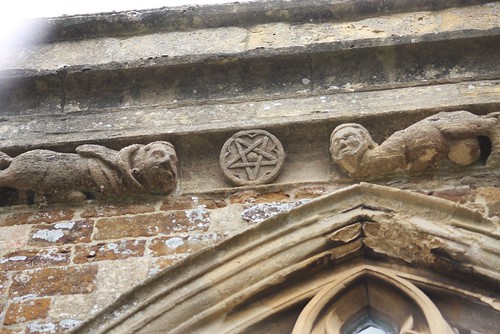
Critics of the Church are uncomfortable with the inverted five-pointed stars found on the stones and in the round windows of the Nauvoo Temple because in modern times they have come to be associated with Satan and devil worship. It should be noted, however, that this association did not occur until after the death of the Prophet Joseph Smith.
It should be further noted that Latter-day Saints publicly disclosed their interpretation of the inverted five-pointed star when they built the Logan Temple in northern Utah. A contemporary newspaper report states that the star was symbolic of "the Star of the Morning"[7]—which in the New Testament is a title of the Lord Jesus Christ (Revelation 22:16).
Some critics of the Church claim that the inverted five-pointed star on some of its temples are a symbol of evil and thereby demonstrate that Mormonism is not really a Christian religion.
The Prophet Joseph Smith indicated that he received the pattern for the Nauvoo Temple by revelation (cf. D&C 124꞉42). He told the architect of the project, "I have seen in vision the splendid appearance of that building illuminated, and will have it built according to the pattern shown me."[8] The Prophet also stated that he had seen at least one of the exterior symbols of that temple in this vision.[9]
The inverted five-ponted star was first displayed on the exterior of an LDS temple in Nauvoo, Illinois in the early 1840s. (See here here here here)
One of the foremen who helped to build the Nauvoo Temple recorded what the emblems on its exterior represented. He said,
"The order of architecture was unlike anything in existence; it was purely original, being a representation of the Church, the Bride, the Lamb’s wife. John the Revelator, in the 12 chapter [and] first verse of [the book of Revelation,] says, 'And there appeared a great wonder in heaven; a woman clothed with the sun, and the moon under her feet, and upon her head a crown of twelve stars.' This is portrayed in the beautifully cut stone of this grand temple."[10]
Joseph Smith revealed the connection between the heavenly woman of the apostle John's vision and the restored Church. In the Prophet's revision of the King James Bible he modified Revelation chapter 12 verses 1 and 7 to read: “And there appeared a great sign in heaven, in the likeness of things on the earth; a woman clothed with the sun, and the moon under her feet, and upon her head a crown of twelve stars . . . the woman . . . was the Church of God.” (JST Revelation 12:1,7).
This is the same arrangement of the symbols on the exterior pilasters of the Nauvoo Temple—moon (bottom), sun (middle), and stars (top).
The stars are associated in the book of Revelation passage with a "crown" which is a symbol of royalty. In another section of the book of Revelation Jesus Christ proclaims His descent through the royal lineage that is within the house of Israel and then pronounces one of His titles: "I am the . . . offspring of David, and the bright . . . morning star" (Revelation 22:16). This is the title that nineteenth century Latter-day Saints assigned to the inverted five-pointed star. One of these emblems was put into place on the east tower of the Logan, Utah temple in 1880. An eyewitness to the event reported the following which was printed in a major newspaper: "Carved upon the keystone is a magnificent star, called the Star of the Morning."[11]
In 1985 Church Architect Emil B. Fetzer stated that the inverted stars on early LDS temples were not sinister but were “symbolic of Christ.” He said that when the Church “uses the pentagram or sunstone in an admirable, wholesome and uplifting context, this does not preclude another organization’s using the same symbols in an evil context.”[12]
A connection between the "inverted pentagram" and Satan "is almost certainly a 19th century invention by Eliphas Levi," who was a "defrocked priest."[13] He did not begin publishing references to this idea until 1854, a decade after the death of the Prophet Joseph Smith.
Below are links to examples of the inverted five-pointed star in ancient Christian usage and also numerous modern usages that have nothing to do with the occult or satanism.
The claim is sometimes made by critics that since the All-Seeing Eye of God is displayed on the exterior and interior of the Salt Lake Temple[14] and the All-Seeing Eye is an emblem utilized by the Freemasons then the Mormon usage must be an indication of a connection between Mormon temples and Freemasonry.
The All-Seeing Eye of God was not a symbol created by the Masonic fraternity and, in fact, was utilized as an emblem in Christian architecture long before Speculative Freemasonry became an organization.
Latter-Day Saints as a group became involved in Freemasonry in early 1842 but, as noted in the timeline below, the All-Seeing Eye of God was a well-established symbol among the Mormons long before this affiliation.
1828–29 – “I pray the God of my salvation that He view me with His all-searching eye” (2 Ne. 9:44).
1828–29 – “under the glance of the piercing eye of the Almighty God” (Jacob 2:10).
1828–29 – “the glance of [God’s] all-searching eye” (Mosiah 27:31).
December 1830 – “I can stretch forth mine hands and hold all the creations which I have made; and mine eye can pierce them also” (Moses 7:36).
2 January 1831 – “Thus saith the Lord your God, even Jesus Christ, the Great I AM, Alpha and Omega, the beginning and the end, the same which looked upon the wide expanse of eternity, and all the seraphic hosts of heaven, before the world was made; The same which knoweth all things, for all things are present before mine eyes. . . . mine eyes are upon you. I am in your midst and ye cannot see me” (D&C 38:1–2, 7).
13 August 1831 – “mine eyes are upon those who have not as yet gone up unto the land of Zion” (D&C 62:2).
1 November 1831 – “Hearken, O ye people of my church, saith the voice of Him who dwells on high, and whose eyes are upon all men” (D&C 1:1).
November 1831 – “Behold and lo, mine eyes are upon you” (D&C 67:2).
31 July 1832 – “my heart is naked before [God’s] eyes continually.”[15]
4 January 1833 – “the eyes of my Maker are upon me.”[16]
May 1835 – “the scrutinizing eye of ‘Him with whom we have to do.’”[17]
29 January 1836 – “[the] Lord had [His] eye upon thee.” [18]
9 May 1836 – “they stand naked and exposed to the piercing eye of Jehovah.” [19]
May 1836 – “God is not mocked with impunity. His all seeing eye beholds you at all times. . . . His all-seeing eye surveys the whole of His vast creation.” [20]
April 1837 – “the scrutinizing eye of Jehovah is ever upon them.” [21]
June 1837 – “In vain do they attempt to hide from the scrutinizing eye of Jehovah.” [22]
20 March 1839 – “Behold, mine eye seeth and knoweth all their works.” [23]
3 July 1839 – “the God of Jacob has His eye upon you.” [24]
September 1840 – “the all-searching eye of an Omnipresent God.” [25]
January1841 – “God that sheweth mercy; having His eye at the same time directed towards His covenant people.” [26]
13 December 1841 – “Let it not be supposed that the sick and the destitute are to be denied the blessings of the Lord’s house; God forbid; His eye is ever upon them for good.” [27]
Summary: Critics argue that the Church of Jesus Christ of Latter-day Saints spends excessive amounts of money on temples when those resources could instead be used to feed the hungry, alleviate poverty, or meet other humanitarian needs. In the eyes of critics, lavish temple construction is difficult to justify in a world with so much suffering.
The Church builds temples because they are divinely commanded, central to its religious mission, and necessary for sacred ordinances believed to have eternal significance, while humanitarian and welfare efforts remain important but do not replace the distinct purpose of temples.
Presiding Bishop Gerald Causse explained the Church's purpose and its focus on how it uses its financial resources:
We are not a financial institution or a commercial corporation. We are the Church of Jesus Christ, and this Church has no other objective than that which the Lord Himself assigned to it—namely, to invite all to “come unto Christ, and be perfected in him,” by “helping members live the gospel of Jesus Christ, gathering Israel through missionary work, caring for the poor and needy, and enabling the salvation of the dead by building temples and performing vicarious ordinances.”[1]
In addition, President Russell M. Nelson taught:
The good this Church accomplishes around the world to alleviate human suffering and provide uplift for humankind is widely known. But its prime purpose is to help men, women, and children follow the Lord Jesus Christ, keep His commandments, and qualify for the greatest of all blessings—that of eternal life with God and their loved ones.[2]
Latter-day Saints believe that these blessings are possible through certain ordinances (rituals) and covenants (promises). These ordinances and covenants are only available in specially designated places, called temples, as explained by the Prophet Joseph Smith:
The main object was to build unto the Lord a house whereby He could reveal unto His people the ordinances of His house and the glories of His kingdom, and teach the people the way of salvation; for there are certain ordinances and principles that, when they are taught and practiced, must be done in a place or house built for that purpose.[3]
It is important to remember these doctrines when considering why the Church spends so much money on temples. There are three possible reasons.
First: The Lord commanded it. In a revelation to Joseph Smith, the Lord commanded:
Come ye, with all your gold, and your silver, and your precious stones, and with all your antiquities; and with all who have knowledge of antiquities, that will come, may come, and bring the box tree, and the fir tree, and the pine tree, together with all the precious trees of the earth; and with iron, with copper, and with brass, and with zinc, and with all your precious things of the earth; and build a house to my name, for the Most High to dwell therein. . . . And verily I say unto you, let this house be built unto my name, that I may reveal mine ordinances therein unto my people.[4]
Second: To honor God. In the revelation cited above, the Lord called for a house to be built "for the Most High to dwell therein." A member of the Seventy explained: "By requiring exacting standards of construction down to the smallest of details, we not only show our love and respect for the Lord Jesus Christ, but we also hold out to all observers that we honor and worship Him whose house it is."[5]
Third: To show how much God honors us. In the revelation cited above, the Lord explained that in His house He would "reveal mine ordinances." These ordinances (and their associated covenants) are gifts from God to His children that provide them with greater knowledge, power, direction, and peace.[6] Consider how you would feel if God wanted to give you these blessings in a dingy, dirty, broken-down building. You would likely feel that God doesn't respect you and that His blessings aren't really worth very much. By building temples with the "precious things of the earth," we show how much God values us and the incredible blessings He is providing to us.
Critical sources |
|
FAIR is a non-profit organization dedicated to providing well-documented answers to criticisms of the doctrine, practice, and history of The Church of Jesus Christ of Latter-day Saints.
We are a volunteer organization. We invite you to give back.
Donate Now